Jenga is a game played with rectangular wooden blocks that stack into a tower with 3 bricks per layer.
The object of the game is to deconstruct then reconstruct in a way that makes the tower precariously difficult for the next player to remove a brick without the whole thing collapsing.
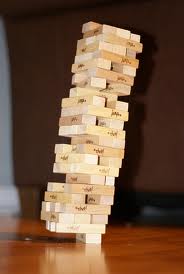
A variation of jenga played in the more sophisticated circles of higher education, allows for the tossing of lightweight objects at the base of the tower. If the object touches the base without knocking it over, the game is won outright, although players may resume deconstructing and reconstructing if they so wish. If the object knocks the tower down, the thrower forfeits his/her right to participate further in that round of the game.
At one university in Belfast near Botanic Gardens, there is a jenga club that has been deconstructing and reconstructing for 17 years. Caps have been tossed, but no winner is in sight. Some suspect foul play. It has been suggested that it is an unorthodox set of bricks with special pegs and holes that give greater stability to the tower. When examined, however, the wooden bricks conform to the precise jenga international federation standards.
Experts have travelled from far and wide to Belfast to witness for themselves this extraordinary phenomenon. An emissary from his holiness the Daily Llama waved incense around the tower and made delicate jingling sounds with brass finger cymbals. The non-conformist Lutheran cleric, Rev. Digby Spratton, has described the playing of jenga as ‘diabolical frippery’ and called for all god-fearing people throughout the world to cease and desist in the playing of jenga, until its supernatural forces can be clearly demonstrated.
The Brazilian Olympic Committee, meanwhile, has intimated that jenga may well be deemed an Olympic sport and have felled a considerable portion of the rainforest in order to stockpile jenga bricks for 2016.
 odespinner