I watched an interesting programme on TV last night on the 14th Amendment to the US Constitution.
“All persons born or naturalized in the United States and subject to the jurisdiction thereof, are citizens of the United States and of the State wherein they reside.”…
The second sentence confers due process and equal protection clauses to everyone in the USA, (not just its citizens).
“No State shall make or enforce any law which shall abridge the privileges or immunities of citizens of the United States; nor shall any State deprive any person of life, liberty or property, without due process of law, nor deny to any person within its jurisdiction the equal protection of the laws.”
It’s hard to imagine the struggle for freedom by slaves in the Southern states of America in the 19th century. The 14th Amendment to the U.S. Constitution, ratified in 1868, granted citizenship to all persons born or naturalized in the United States,including former enslaved people,and guaranteed all citizens “equal protection of the laws.”
The Reconstruction era in the USA, 1865–77, followed the American Civil War during which attempts were made to redress the inequities of slavery and its political, social, and economic legacy and to solve the problems arising from the readmission to the Union of the 11 states that had seceded at or before the outbreak of war.
While US President, Andrew Johnson, attempted to return the Southern states to essentially the condition they were in before the American Civil War, Republicans in Congress passed laws and amendments that affirmed the “equality of all men before the law” and prohibited racial discrimination, that made African Americans full U.S. citizens, and that forbade laws to prevent African Americans from voting.
The Compromise of 1877 was an unwritten deal, informally arranged among U.S. Congressmen, that settled the intensely disputed 1876 presidential election. It resulted in the United States federal government pulling the last troops out of the South, and ending the Reconstruction Era.
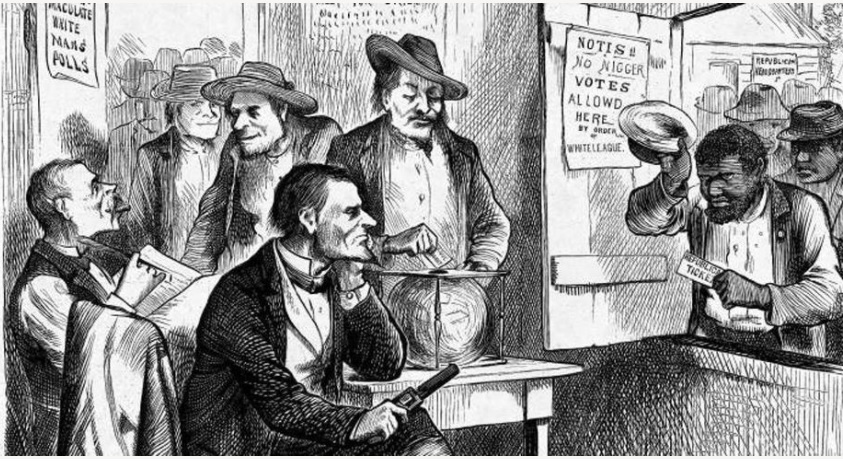
During the 12 years of the Recontruction Era hope was offered to black people, and former slaves generally, that times were changing and their rights were being protected. The Southern backlash by racist anti abolitionists saw thousands of black citizens lynched and political power restored to their white oppressors. Without the protection of federal troops, violence reigned supreme and the mass slaughter of black people ensued. There follwed an exodus of 6 million black people to cities like Chicago, Cleveland and Oakland.
The Supreme Court denied black people the equality and protection stipulated by the 14th Amendment by misinterpreting the law in bizarre ways so that violence could be carried out by individuals on black people and their property as long as the State was not directly responsible. In the same way, a Theatre Company could refuse admission to black people because that was an act by a private company.
Ida B. Wells was an African American journalist, abolitionist and feminist who led an anti-lynching crusade in the United States in the 1890s documenting the atrocities. Her expose about an 1892 lynching enraged locals, who burned her press and drove her from Memphis. After a few months, the threats became so bad she was forced to move to Chicago, Illinois.
 odespinner